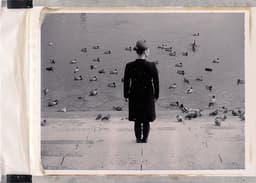
it’s like
having a nightmare
you can see someone you care for you love they’re in danger
you open your mouth to yell warn them but
you can only squeak croak they can’t hear can’t hear can't hear
and your vocal chords vibrate with desperation and your throat is empty
you try to run move them push them wake them up
but your legs are stuck can barely twitch
you can feel the kinetic energy rippling in your muscles
but your legs they just won’t move won’t move won't move—
and then you see really finally see
it’s not just someone it’s you it’s YOU
but you didn’t know didn’t recognize couldn’t remember
who fed you thirty pounds what bird has been
pecking red sores into your chin who painted
purple blooms under your eyes and drained your red
your life turned your skin grey like a corpse
who sits on your shoulders they slump in defeat
it’s you it’s a stranger
it’s not right not right not right—
it’s like
you wake up and the nightmare has ended
but you still can’t recognize so you make a mask
foundation give your skin human pallor
concealer covers the pimples you gouge covers the purple petals
blush makes cheekbones full and warm not sallow
black and color gives your eyes a smile the one they lost they forget
you’re proud of your work it is humanoid it is a lie
you have to be careful watch closely
reapply frequently fill the cracks erase them
you carry your face in a bag like some great treasure
they won’t know you’re just a marionette
little wires in your joints smoke and mirror empty hollow
they’ll never know never know never know—
it’s like
trying to answer that question how are you
you want to say I’m not okay I’m sad angry numb riddled with anxiety
can’t sleep can't enjoy can’t help myself can’t even cry
you want to tell them but your voice has been stolen
it runs backwards upside down nonsensical
your tongue is thick tied into knots it lies so easily
I’m fine can’t complain
because
really you can’t
because
what about drought famine starvation
what about disease plague death
just ignore that I’m sad give me sympathy
it’s my fault my fault my fault—
it’s like
you’ve been horcruxed in two
one part is small weak quiet it wants to change to change
quit smoking
eat vegetables
run faster
get a dog
do better
be better
see things
go places
be alive ******
but the other part is loud loud loud strong and loud
it tells you stop thinking you’ll be happier
stop thinking
lay in bed for three days straight
stop thinking
drink ten cups of coffee before noon
stop thinking
chain smoke through a convenience store
stop thinking
ignore those messages
stop thinking
close that book
stop thinking
put down that pen
stop thinking
stop thinking
stop thinking
stop thinking
you’ll be happier stop thinking
just freeze right here **** that puny part of you
smash it to bits bury it deep dark
pour concrete over top then build a skyscraper there
one with pretty lights it’ll point at the sky
you'll be distracted you won’t hear it
won’t remember won’t remember won't remember—
it’s like
you’re a brain with a disobedient body you want to listen think feel be
you’re poisoned frozen stuck limbs wither muscles atrophy heart freezes
you're just numb empty nothing nothing nothing—
*you’re billy pilgrim
but no alien zookeeper
you’re lady lazarus
but no phoenix courage
you’re just that foot
you do not do you do not do
you just sit in that old black shoe*—
and if you open your mouth they’ll know they’ll all know they'll know
you’ll speak it into existence
so you sew it shut lose the scissors forget
if you never say it it never has to be real
so you just pretend you just ignore ignore ignore
you're not empty hollow numb you're not nothing
you’re just fine, thanks, and how are you
they love your lie devour it are sated by it
you are sated too
Feb 21, 2017
Feb 21, 2017 at 4:40 PM UTC
I was the daughter of winter
when you began to whisper
in my frigid ear. I lifted two
snowballed hands and chiseled
through the solid ice; bitter
words pierced the raw mist
surrounding me, but you were
not disarmed. I tried to stop the
thawing, dreamed lustily of a
rapidly approaching sleep,
that deep freeze and muffled
silence. You stayed, shivered,
and I was suffuse in tender
sunlight, for you were an
Indian summer, a falsehood
by very nature—false hope,
false promises, false warmth.
Your lilting birds and sultry
air enchanted—I was dizzy
and drunk, melting slowly.
You sang in the soft breezes,
danced frantically in the wake
of falling leaves, and swore
with each delicate blue sky:
It will always be this lovely!
But you were just a charade.
I was no more than a pool,
heated from the diminishing
glow of your fervor’s twilight,
and Autumn waited, patient,
as the mask finally slipped.
Feb 9, 2015
Feb 9, 2015 at 1:10 PM UTC
You were the first one to
take a true interest, that night—
not just drunk lips
clamoring for a mate
or clumsy hands
groping at my thicker bits
but prudent whispers,
foreplay,
misdirection,
that careful waltz.
You were the first one to
kiss me like you wanted nothing,
though we both knew
you needed everything.
I can still recall the distinct
flavor of your mouth
against mine,
how its absence left
my lips swollen,
that triumphant cigarette
a foreign shape as you
walked away.
You were the first one to
see what hid beneath those
winter layers. You were
impatient, ravenous,
but charming.
I was timid, awkward,
and terrified.
Don’t ever be sorry,
you said,
slipping into that
mischievous simper,
but you soon found more fertile soil.
Dec 10, 2014
Dec 10, 2014 at 10:16 PM UTC
O slimy tongue!
O patient tourist!
Your slow retreat has
left a lustrous spoor.
How admirable,
your bold simplicity—
no radiance to distract,
no carapace to fortify.
How you coil and flex,
a solitary finger
sliding across our
forgotten places.
How we yearn to
pet your soft tissue,
to feel its cool shiver,
the recoil of desiccation.
How honest the world
must be from below as
you devour the decayed,
savor that sour brutality.
Dec 7, 2014
Dec 7, 2014 at 2:55 PM UTC
He was born in the rendezvous of a clap of thunder
and a shooting star, fully grown and bigger than
a mountain. When they asked him who he was,
he said, A Wanderer, and when they asked where
he came from, he said, She left me, and no more.
But he was ravenous, ate splintering trees with all
their monkeys and birds and lizards, then washed
them down with murky rivers teeming with fish and
frogs and crocodiles. Soon the once-green valley was
a bony desert, and still he wanted more, so he cracked
his teeth on salty boulders, then swept his fingers
across the soil, creating massive tributes to his hunger-
fueled ruin in the soil and licking the grit off of each
digit, savoring the bitter zest of his destruction.
And when his throat was caked, they pointed to
the ocean, and he ran—an earthquake—to the
gloomy deep. He made himself a bed down there
of slime and old shipwrecks, slurping squid
and jellyfish until the day that she comes back.
Oct 3, 2014
Oct 3, 2014 at 11:15 PM UTC
On my first Christmas,
I learned that the city of
towering cardboard boxes
and the crunchy ocean
of kaleidoscopic paper were
destined for the trash bag,
but the complicated toys
I could not yet understand
were mine to keep.
Just before my second birthday,
my parents came home
with a pink, wrinkled
bundle of flesh, and said,
This is your new sister.
Though, at first, I found her
beautiful, with those pill-
sized fingernails and the
soft coos she kept pushing
out, I was horrified to
learn that my grandparents
were not taking this baby
with them, that she was
not here for my entertainment.
But the envy soon faded,
and I kept a lifelong friend.
At eight,
I decided not to keep
the magenta cast after
the stoic doctor sawed it
loose. It was caked with
doodles and kind notes, but
it stunk of sour milk, and
the boy with the copper
hair had not signed it.
I could not forget his
taunting laugh as I fell
that day, nor the fiery flush
that shaded my cheeks as he
snatched his hat from my
hand, already numb and
quickly swelling with
humiliation.
By eleven,
I had spent so much of a
childhood tripping over
sentences and paragraphs
and essays that when
my book report bloated
slowly from two pages to
five to eight to ten to thirteen,
I unknowingly conquered my
fear, stumbling over a
voice begging to be kept.
When I reached fourteen,
I had seen two corpses
in one year—one painted
as though in the height of
Expressionism and resting
in a casket so cheap it could
have been cardboard, one fat
and covered in smooth
fur, collapsed onto the cool,
indifferent metal of the
vet’s table—and I learned
that breath is in short supply.
But I also learned that
the destination matters less
than the odyssey, so I
tucked my grandmother
and my beagle into my
front pocket like two crisp
hundred dollar bills, kept them
with me wherever I traveled.
Oct 3, 2014
Oct 3, 2014 at 11:14 PM UTC
was the sort of kid who would have enjoyed dissection
in high school, savoring in the permission to cut
a once-living creature open and scrutinizing the
parts that made it function,
would draw swastikas on furniture and his toys and his
body not because he was an Anti-Semite but
because he thought that maybe it could start
a conversation or two,
mixed different sorts of alcohol in his bedroom and claimed
to have brewed them himself because he
thought he could impress the friends whose
palates discerned the lie,
wore heavy black clothing even in the drought of August
or red-colored contacts and a black eye
eye patch because he thought this made
him intimidating,
carried an immense duffel bag packed so tightly with
dull-edged katanas and worn flasks
and umpteen lighters and extra shoes
it could not be fastened,
always smoked two cigarettes in succession as if
to say to everyone: smoking is
cool and now I am twice as cool
as the rest of you,
was so captivated by explosions that he poured
drain cleaner into bottles filled with *****
of tin foil and claimed to be creating a
recipe for ******
did not believe in moderation and always ate until
his gut distended or drank until his pallid
skin greened or smoked until the bag was
empty and the room a thick haze,
never cared that his name was simply Rob and his
ever-changing group of friends insisted
upon adding the ‘Crazy’ since he had been young,
never hesitated to share his time or money
or material possessions with every person he knew,
never made apologies for his outlandish and
off-putting behavior because he was comfortable as
himself and was committed to enjoying
every moment of every day with unabashed gusto.
Oct 3, 2014
Oct 3, 2014 at 10:46 PM UTC
When we arrive at the beach, the oppressive sun has
begun his slow, creeping descent towards the gap in
the dunes where, if one stood at the very crest, he
might see the swampy bay, tufted in tall, thin grass
and dotted with ospreys and cranes. I carry a bag
depicting a bastardization of the American flag, and
he tugs the narrow mesh cart with cartoon wheels across
the flesh-toned sand. The crowd of hungry beachgoers
is thinning, and the lifeguards have just begun to lug
their tall wooden stand back from its perilous proximity
to the gentle breakers. I walk just a few paces behind
my father, until he stops, asking, “Is this a good spot?”
I nod, never before remembering a time when he
sought my approval for a seaside roost. After ******** our
umbrella—blue-green, as though reflecting in canvas
the fluctuating shades of the mutable Atlantic—deep into
the cool sand, and setting the two chairs firmly in its chilly
shade, he asks, “Wanna swim?” Again, I nod, stripping
until I wear nothing but a mint green bikini and sunglasses.
Leisurely, we stroll towards the small waves and wade into
the just-right water gradually. Subconsciously, I am again
just three or four footfalls behind his frame, as if I cannot
continue any deeper until he has tested the sea, and each
step forward is a promise that everything is okay,
and I may proceed with caution.
Our steady immersion suddenly releases in me a torrent
of memories. I see myself, maybe seven, planted next
to him on the beach, where the sand is only just damp,
digging holes with our hands so that a small pool of
icy liquid slowly emerges, and then cupping the sand
and carefully dripping it along the edges to create a
system of fortresses and castles melting in the breeze.
I see him explaining to me, age nine, the proper way
to bodysurf, and I feel once again a sudden fear that
the salty water will fill my nostrils and cause that
choking burn that I detest to this day. I remember
him laughing that hearty guffaw as I was, invariably,
thrown from my boogie board in the aftermath of a
particularly large wave, skinning my knees against
the broken shells dotting the rough ocean floor. I
hear his careful instructions about the proper and
improper behaviors when ****** into a rip tide—
swim horizontally, he’d say, and if I didn’t understand
the word, he’d clarify that it meant to follow the beach,
because following the sea was certain death.
When our waists have just begun to adjust to the
temperature, I overhear the father of a girl who is
about the age I was in these memories exclaim that
a pod of dolphins has come quite close, and upon
looking, I see their gray bodies slithering in and out
of the deeper water. I nudge my father and point, and
we both marvel at this rare occurrence. Thousands of
seconds pass, and this time he is pointing off in the
distance, saying, “They’re still hanging around. Must
be a school of fish or something.” When I ask him if
he knows why they are within swimming distance,
he tells me confidently that it must be due to the
water’s unseasonable warmth, and I know in my
heart and in my brain that he is correct, as usual.
After the dolphins have disappeared, I say that I
am done swimming, that I want to start the Marquez
tome weighing heavily upon my conscience and that,
besides, we shouldn’t leave our valuables alone for
too long. He simply shrugs, as if to say, “Why would
you want to get out of this ocean?” almost as though he
didn’t realize thievery is such a common occurrence
at the Jersey shore. From my haven in the shade, I
feel goosebumps emerge as my father’s shirt deepens
from heather gray to taupe. Before leaving the
house our family has visited every summer for over
a decade, I borrowed his brand new headphones—he
was so excited to tell me that they don’t knot—and
their bulbous coverings, when stuck in ears on a
windy beach, create the sort of howling found in
1970s horror movies, my own personal FX. Despite
the fact that I have just surpassed one quarter of a
century in age, I still see him, a few years past the
half-century mark, turn around, squinting, until he
sees me safely planted in the plastic chair, as safe
as a father could hope his oldest daughter to be.
Jul 12, 2014
Jul 12, 2014 at 11:30 PM UTC
For me, paradise is the sight of a soft
sunset, when the sky just above the tree
line is blushed with pink and swept with
clouds so fine and wispy I think that
they must have been painted by a hand
the size of Asia or a small galaxy.
It is the end of a day so stiflingly hot
and humid that my skin still steams
after hours reclining in artificially
cooled air, and when I venture to the
red chairs on the front porch, their
metal no longer sizzles, but, like me,
relishes in the tickle of a gentle breeze.
It is the conniving but stalwart beagle
who lies on the fourth step, squishing
his face against the end of the banister
so that the skin of his black lips are pulled
into an easy, familiar grin, his speckled
tail thumping against the cerulean carpet.
It is the joyous surprise of catching a
beloved and long-forgotten tune on the
fickle radio—humming the haunting
melodies and crooning the words
imprinted upon my soul elicits a face-
splitting smile, and a steady swelling of
bliss and glee deep within my chest cavity.
It is the comfort of my childhood home,
every inch so recognized I could navigate
its rooms in pitch black, locate a fork or
a heavy blanket with ease. It is the serene
beckoning of my bed after an arduous
day, its sheets always warm in the winter
and cool in the summer. It is the
imbibing of my favorite beer, expertly
cooled, while sharing company with my
favorite people. It is a firm and caring
embrace, the selfless and boundless
love of parents, the first lick of an ice
cream cone, the middle drags of a
cigarette, and the smell of the pavement
as summer rains begin to fall. It is
finding contentment, oozing self-confidence
growing acceptance of the things one cannot
control, the letting go of grudges, the start of
a new friendship and the simplicity of an old
one. It is the stubborn pride that lingers
after one has created something new and
beautiful, and the satisfaction drawn from
finding something thought to be irrevocably
lost.
Paradise is
subjective,
imperfect,
straightforward.
I only wish I
had recognized
this sooner.
Jul 7, 2014
Jul 7, 2014 at 7:43 PM UTC